
Your clients have a plan. Do you?
Align your marketing efforts with this simple, one-page plan.

There are dozens of clichés I could hurl at you about the importance of planning.
But that’d be a waste of time — you’re a financial advisor, I don’t need to sell you on planning, it’s one of your core services. You probably believe (rightly) that investors who don’t have a plan are exposing themselves to unnecessary risk and a directionless portfolio.
And yet, if I had to guess, you probably don’t have a marketing plan. 😬
According to Broadridge, only 3 in 10 advisors have a defined marketing strategy, even though advisors with a plan bring on 50% more clients than those without one.
Perhaps a tiny voice in the back of your mind is whispering, “Well, that’s just one survey…”
Fair point. Then I’ll direct you to Schwab’s 2024 Benchmarking Study: Firms that document their ideal client persona, value proposition, and marketing plan attract 67% more new clients and new client assets than those that don’t.
Two studies. Same result.
A documented marketing plan isn’t optional if you want growth. But creating one can feel like its own hurdle because (a) it sounds time-consuming and (b) most advisors don’t have much free time to begin with or know where to start.
Time to fix that.
The One-Page Plan (That You’ll Actually Use)
Let’s start small, literally. Because something is far better than nothing — and in most cases, simpler is better.
Think of this as a one-page financial plan you might build for a client. It’s not meant to capture everything, but it gets the most important information down on paper: structure, concrete direction, and a reminder of what the client is working toward.
A one-page marketing plan can do the same. Before you can build your plan, though, you need a simple mental model to map it to: the marketing funnel.
The marketing funnel
Most activities fall into one of three stages: Attract → Nurture → Convert
Attract: How people first discover you (e.g., LinkedIn posts, SEO, ads, referrals, partnerships)
Nurture: How you build trust and demonstrate value (e.g., newsletters, videos, webinars, guides, lead magnets)
Convert: How you turn interest into action (e.g., consults, onboarding calls, remarketing)
Most advisors unintentionally overcommit to one area and ignore the rest. However, without a dedicated and intentional approach to each stage, you’re either shouting into the void or leaving interested prospects hanging.
Prospects may find you through any number of channels, and the actual content that nurtures and resonates will likely vary as well. So it can help to visualize this as an actual funnel:
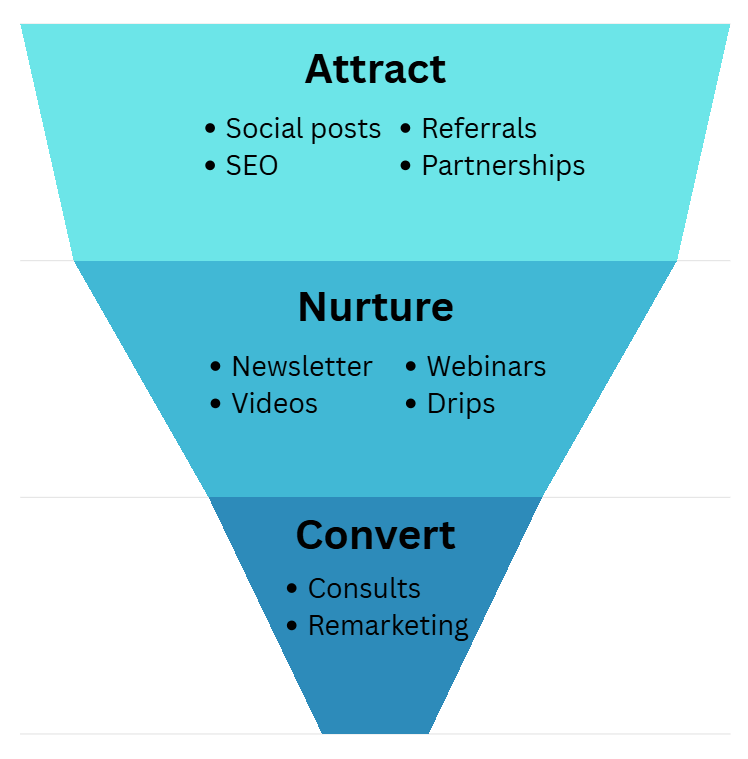
Note: This is not an exhaustive list of examples. Also, in many cases, marketing assets fit into more than one phase (e.g., a prospect finding you through one of your videos).
Now, let’s explore the one-page plan.
What should go into a one-page plan?
Below is a sample layout you can use as a starting point.
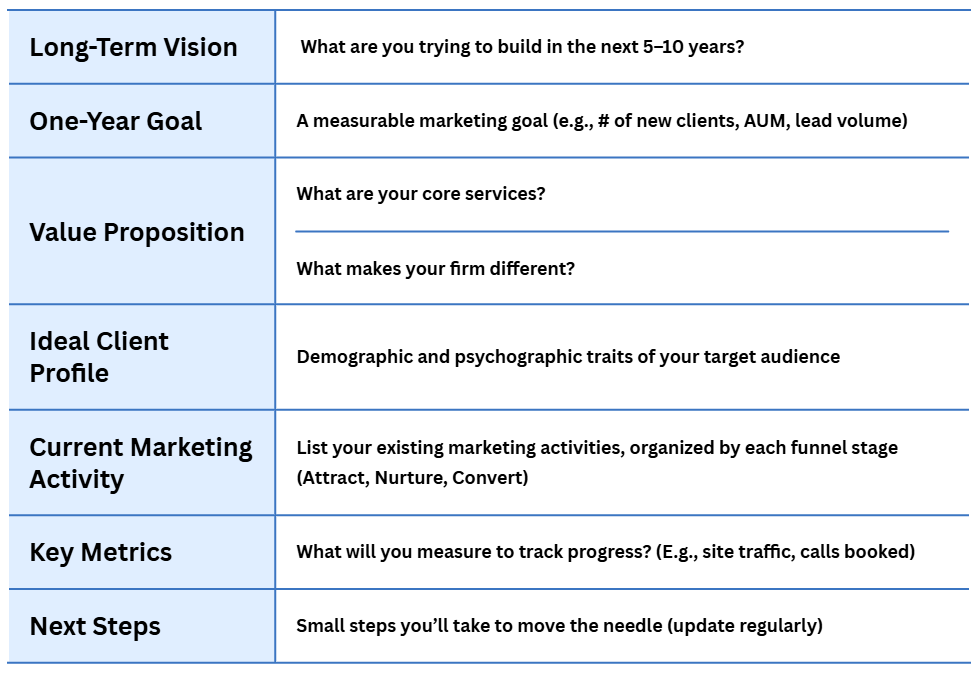
As always, we’ll walk through this exercise from the fictitious perspective of AUM Advisors, assuming that:
We have a general idea of our long-term vision and one-year marketing goal
We have fairly standard core services, but haven’t quite articulated our value proposition or unique differentiator.
We know our audience
We take a DIY approach to marketing, and it’s generally sporadic
We’re unsure what metrics are important
We’re unsure about next steps.
This month’s prompt sequence doubles as self-assessment. By asking ChatGPT for a list of targeted questions, you can start to contextualize your practice’s marketing situation: what’s working, what’s not working, what you know, what you’re unsure about, and so on.
As you’ll see, we have a relatively deep backstory for AUM Advisors. I encourage you to dedicate at least 15 minutes to answering these questions — the more detail/insight, the better.
We'll build on this next month, including ways to tighten up your value prop.
Until next time,
—Carter
Financial Copywriter | Founder of Assets Under Marketing
P.S. If you haven’t already, don’t forget to subscribe: