
Taking a punch and building trust
Steady communication is your most underrated growth and retention tool.

“Everyone has a plan until they get punched in the mouth.” — Mike Tyson
Volatility feels a lot like that punch.
Jarring.
Disorienting
Physiologically painful.
Except advisors know it’s precisely in these tumultuous periods that their guidance is most appreciated, because volatility tends to amplify what clients value most: knowing someone is in their corner.
That’s why this month’s issue highlights a simple but often overlooked tool for reinforcing relationships: timely, relevant content that speaks directly to what clients are thinking. And feeling.
Featured Content Idea of the Month: How Investors Can Take Advantage of Volatility
Why tackle this topic right now? Because volatility is everywhere.
Between retaliatory tariffs, inflation concerns, and recession chatter, investors are understandably nervous. Market uncertainty isn't going anywhere soon, but that doesn't mean investors should sit on the sidelines. Instead, advisors should help clients understand that volatility can present valuable opportunities.
This month's content idea positions you as a steady, proactive guide — exactly what anxious investors need.
Below, I’ve outlined a structured prompt sequence that you can copy and paste directly into ChatGPT (or your preferred AI platform). This is designed to help you efficiently produce a clear and actionable article for clients and prospects.
AI Prompt Sequence
You’ll hear me say this every time, but the initial prompt sets the stage: the more input you provide, the better the output. You might also consider attaching examples of content that you’d like ChatGPT to emulate, whether that’s for certain angles, topic depth, and/or writing style.
Prompt #1
Act as: Expert copywriter and content strategist for the Firm
Firm: AUM Advisors, an independent fee-only advisory firm
Project: Blog Post (which we will prefer to as post 001)
Style: Professional but high readability
Tone: Evocative, experienced, informative, clever, affable
Topic: How Investors Can Take Advantage of Volatility
Context: Recent market conditions have been notably volatile, driven by geopolitical tensions, trade disputes, and economic uncertainty. Clients are expressing anxiety about short-term portfolio performance and potential long-term impacts.
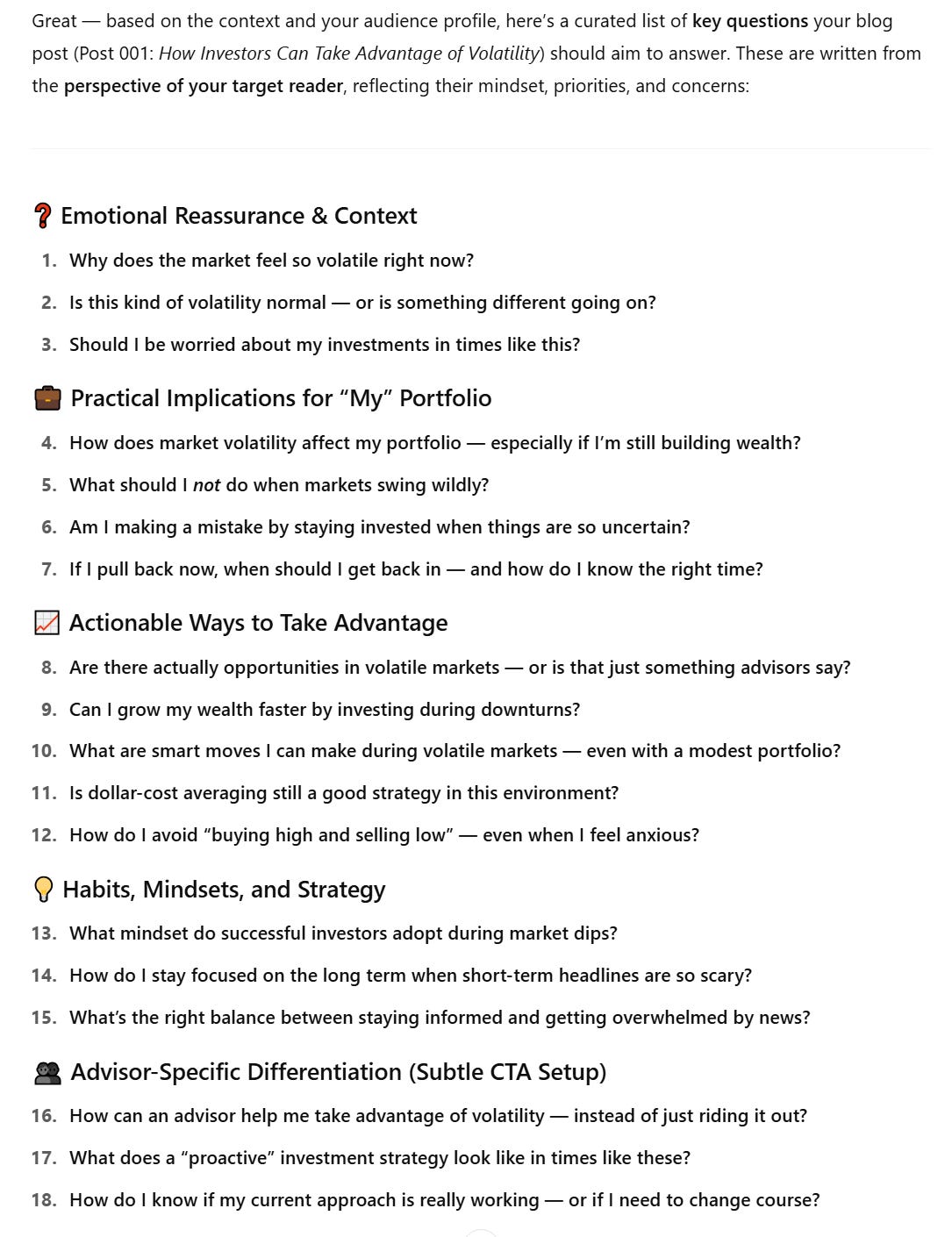
Assignment: Based on the provided context, provide a list of key questions to answer for the blog post; these should be from the perspective of the target audience.
Audience:
* $100K–$1M in investable assets; typically early-stage accumulators or mid-career professionals building wealth.
* Younger, dual-income households, professionals, small business owners, or mid-level executives in [REGION]
Focused on getting organized, building good financial habits, and growing wealth.
* Desire to balance paying down debt, saving for goals (home, education, retirement), and managing risk.
* Feeling unsure if they’re “doing enough” to build a solid financial foundation.
* Overwhelmed by multiple financial goals competing for attention.
* Limited time or financial literacy to confidently manage investing, insurance, or tax decisions on their own.
Notes:
Tailor the audience overview to your firm’s ideal client profile
Review the list of questions — tweak, remove, or add as you see fit.
Prompt #2
Considering every chat is unique, your AI companion’s response could look quite different. Either way, based on our instructions, you’ll have a list of questions to sort through. These questions will drive the depth and length of this article (I recommend aiming for 1,000 to 1,500 words).
Let's focus on [2, 4, 6, 8, and 18]. I think 4 and 6 can be addressed in the same section. I see 18 as a possible concluding section that tees up a CTA. With these in mind, provide a potential outline that addresses these questions in an optimal flow, including SEO-aware headers and header tags, section descriptions, and source-backed stats.
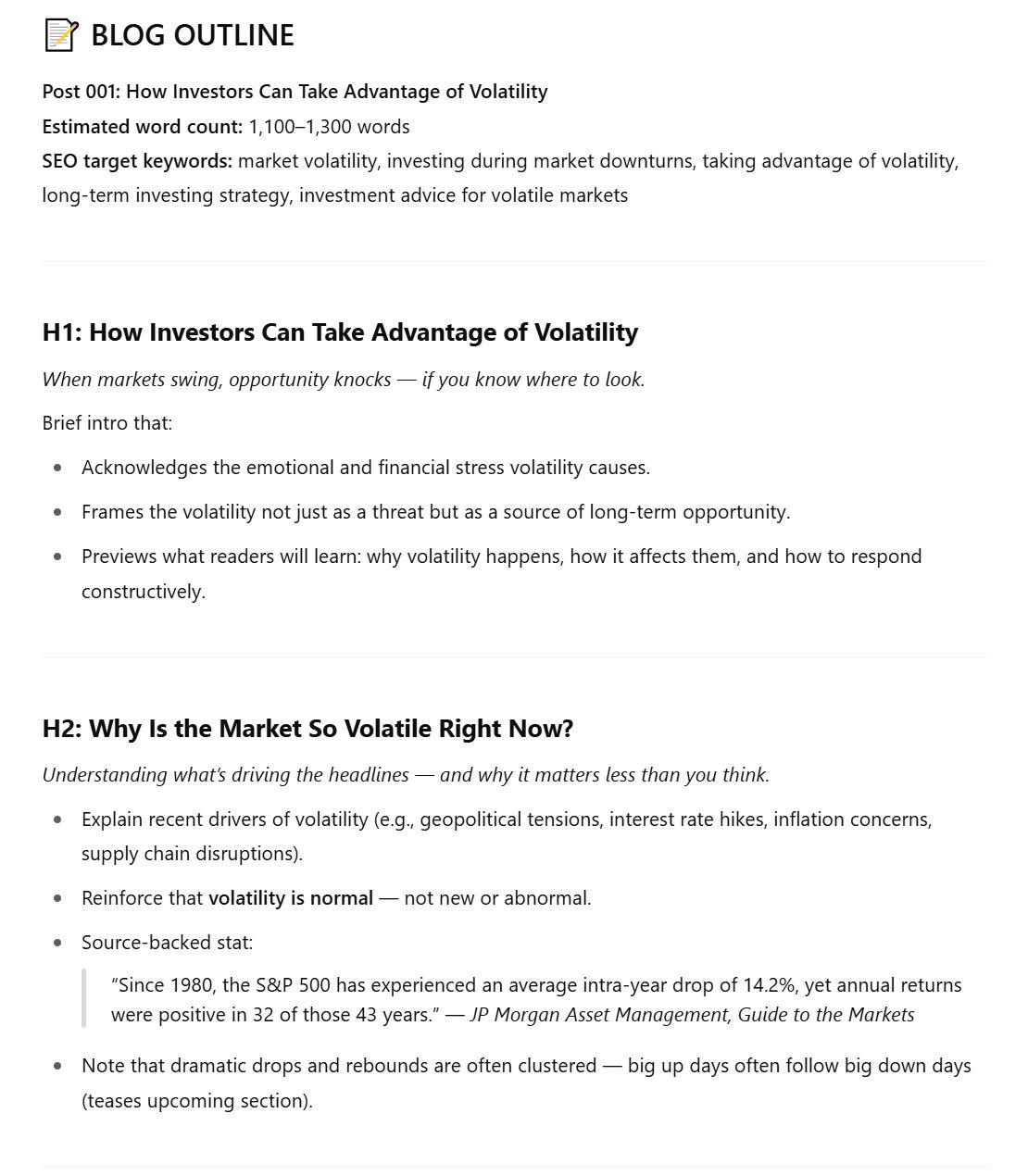
Screenshot has been clipped for length.
Notes:
Review the outline. Provide specific feedback (e.g., “I’d like to recommend Roth conversions; where would this topic best fit?) and make any changes/removals.
Prompt #3
From here, we’ll start drafting the post — one section at a time.
Why? Because the more responsibility you hand off to ChatGPT (or any AI tool), the shallower the response. We don’t want rushed, surface-level commentary.
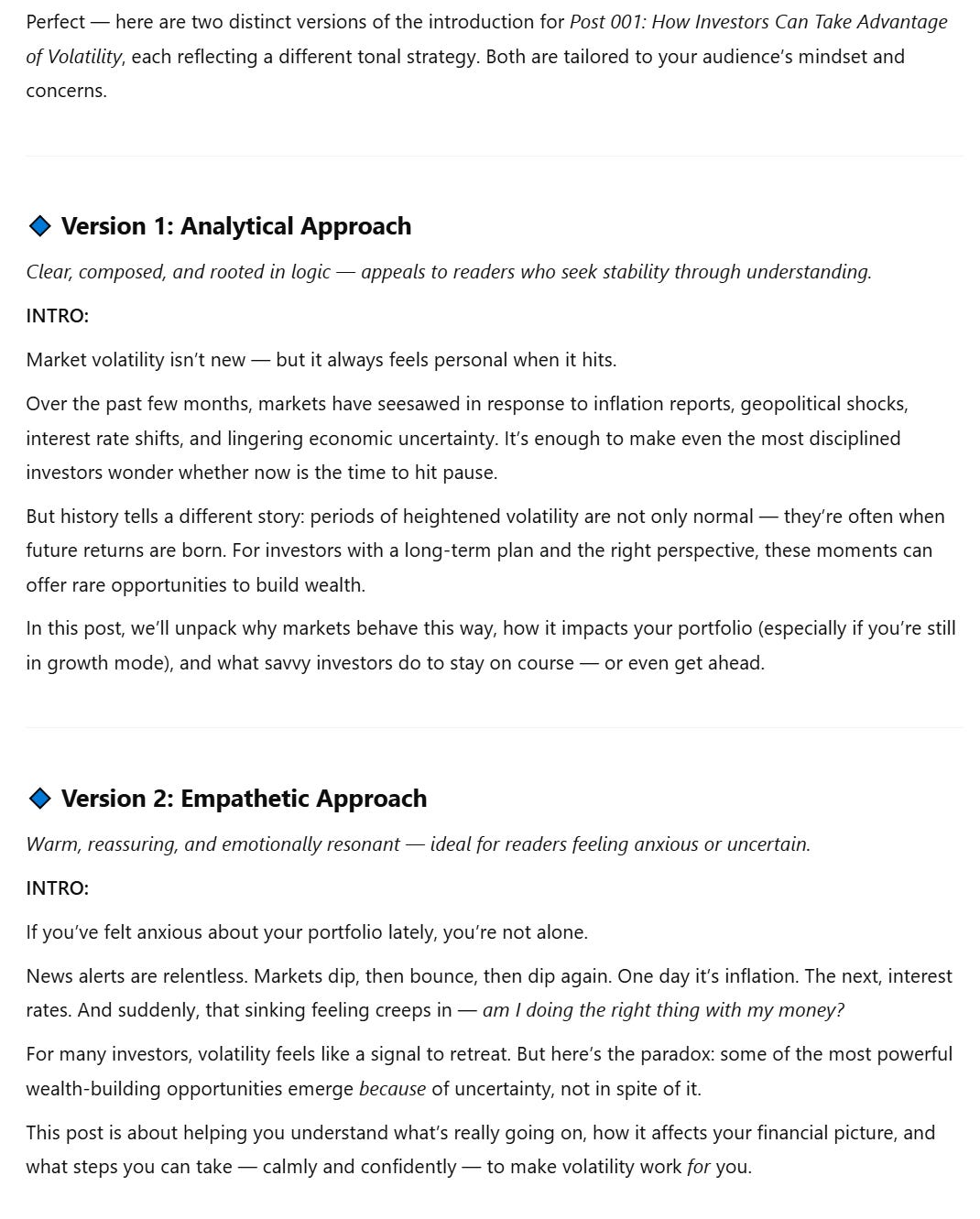
Not bad. I'll provide specific feedback as we draft each section, one at a time. Provide two unique versions of the introduction, one taking an analytical approach and one taking an empathetic approach.
Notes:
For my feedback on this intro, you can review the full conversation (link at the end of the prompt sequence). We’ll skip ahead to the next section.
If you want AI to reference a particular stat or angle, include it in the prompt. For example, the following JPM article includes compelling rolling annual returns data that you could ask ChatGPT to integrate.
Prompt #4
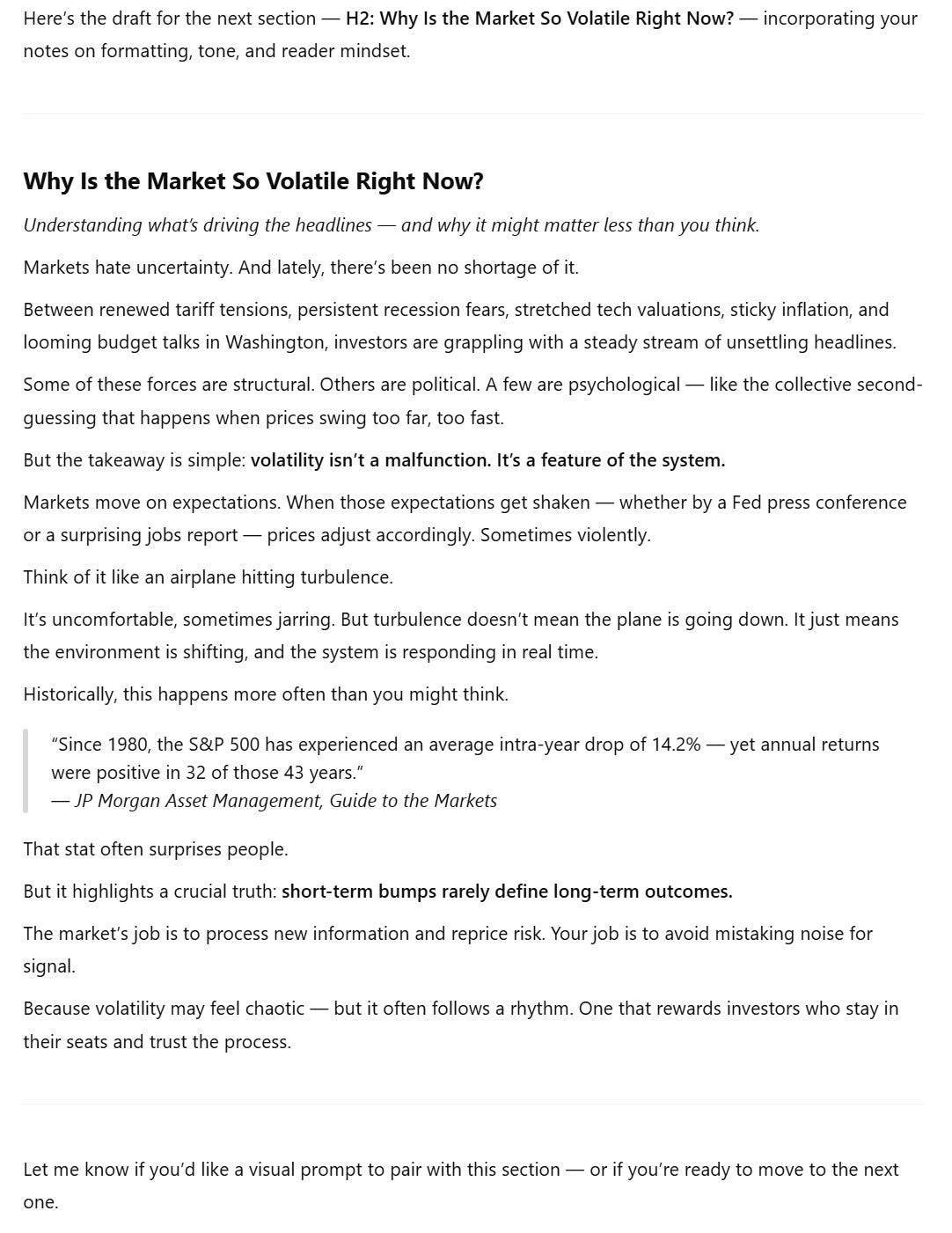
Let's proceed to the next section: H2: Why Is the Market So Volatile Right Now?
Outline feedback:
- All good, except for recent drivers, we can list: tariffs, recession fears, tech valuations, sticky inflation, and budget talks.
Based on our outline, provide a draft with the following formatting notes in mind:
* Occasionally, take advantage of white space, mixing in one-sentence paragraphs every now and then to accentuate key points.
* Use analogies and examples to simplify complex financial concepts. These shouldn’t be over the top though, to the point where they’re patronizing.
Ex: It’s easy to lose yourself in the numbers of retirement planning, but we all have to see the forest for the trees. By painting the big picture (i.e., the life you want) the finer details can fall into place.
* Mix in concise, evocative statements where appropriate.
Ex: When you look at your retirement account statements, what do your eyes immediately snap to? A dollar figure. This number looks real. It’s tangible. You can see it, monitor it, and watch it move in real time. But in reality, it’s theoretical.
* Avoid fluff or unnecessary prose.
Notes:
In this particular prompt, we use formatting notes to guide ChatGPT’s writing style. You can (and should) tweak the formatting notes to your liking.
In my feedback, I made a general note not to overuse conjunctions to start sentences. For example, "But the takeaway is simple" doesn't need the "but."
I also asked ChatGPT to naturally integrate the stat into the narrative instead of using a block quote and provide a link to the source material as well.
Be wary of stats and research. ChatGPT sometimes generates random figures without sources. In this case, it was a reliable source that I verified. I highly recommend asking ChatGPT to provide sources whenever it references a figure, or provide your own.
For the sake of space, you can review the full conversation here and take the gist of my feedback into account as you draft with ChatGPT. You’re free to take sections (or even the full draft) of my example article and use them as your starting point.
Ready-to-Use Email
Subject line: Making sense of market volatility
Body:
If recent market swings have left you feeling uneasy (maybe even queasy), you're not alone. Between headlines about tariffs, recession fears, and constant market fluctuations, it's natural to wonder: "Should I be doing something differently?"
Here's the good news: periods of volatility can offer strategic opportunities for disciplined investors. I've outlined key strategies you can use right now to confidently overcome this turbulent environment and position your portfolio to benefit from the uncertainty.
In this month's featured article, you'll learn:
Why volatility isn't always bad news for your investments
How market dips can help boost long-term returns
Practical strategies, like rebalancing and tax-loss harvesting, to make volatility work in your favor
Don’t let uncertainty disrupt your plan. Find out how to take advantage of volatility.
[Read the Article]
Have questions or concerns? Reply directly to this email — I’m here to help you stay calm and confident, no matter what comes next.
Warm regards,
[Your Name]
[Your Firm]
Ready-to-Use LinkedIn Post
Volatility is an opportunity.
Historically, some of the strongest investment returns and long-term value plays emerge because of uncertainty, not in spite of it.
In my latest article, I break down how you can confidently overcome volatility and strategically strengthen your portfolio, covering practical strategies like rebalancing, tax-loss harvesting, and more.
👉 [Link to full article]
#investing #marketvolatility #financialplanning
Marketing Tip: Don’t Waste Precious (Digital) Real Estate
Many advisors and wealth managers overlook their email signatures. This small space may not seem like much, but why not take advantage of every square inch of digital real estate you have?
Your email signature can be a gateway to further engagement, with minimal setup and effort. By optimizing this space, you ensure that each email carries a potential touchpoint that can lead to deeper client engagement or new client inquiries.
Considerations:
Use a standard font that matches your brand for consistency across all communications.
Incorporate links to your professional website, LinkedIn profile, or recent publications. This makes it easy for recipients to learn more about your services or follow you on social media.
Add a small banner or a call-to-action (CTA) in your signature that promotes a new service, upcoming webinar, or a downloadable resource (like a white paper).
Consider adding a line about a recent award or recognition you’ve received to build credibility and make a strong impression.
Example:
Austin U. Miles | Certified Financial Planner
AUM Advisors | Tel: 555-123-4567
Visit Our Website | Connect on LinkedIn
Download Our Free Guide to Retirement Planning
[Voted Top Financial Advisor by Barron’s, 2025]
Quarterly Content Planner: Q3 2025
This section helps plan content around timely topics that resonate with your clients and prospects. Use this calendar as a guide to reduce decision fatigue and keep your communications strategic and engaging.
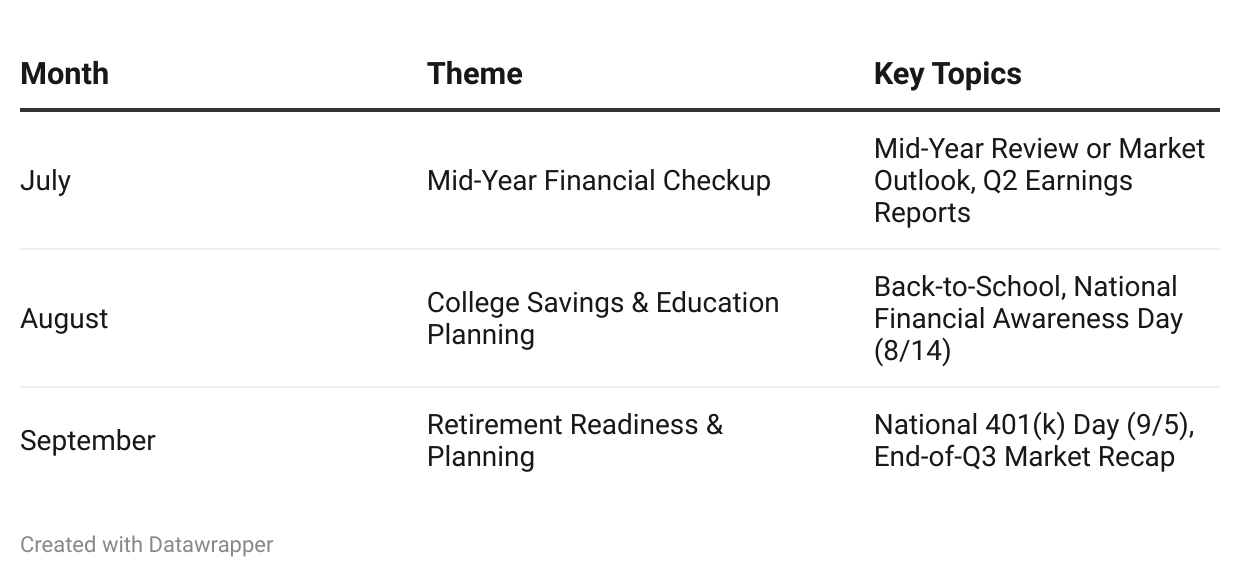
July: Mid-Year Financial Checkup
July is a perfect opportunity for investors to evaluate their financial goals and portfolio progress. Consider creating a brief checklist or mid-year financial “pulse check” to help clients stay proactive.
Content Idea: “Mid-year market update: Are you on track to reach your 2024 financial goals?”
Quick tip: Turn your checklist into a LinkedIn carousel post for visual engagement.August: College Savings & Education Planning
With back-to-school season arriving, August naturally prompts families to think about education costs. Create helpful, straightforward content on funding higher education, maximizing 529 plans, or balancing education savings with retirement planning.
Content Idea: “How much should you realistically save for college and what’s the best way to do it?”
Quick tip: Share a concise infographic outlining the basics of 529 accounts on social media.September: Retirement Readiness & Planning
National 401(k) Day falls on September 6, so it’s the ideal time to revisit retirement strategies with clients. Produce educational content that addresses common retirement uncertainties, outlines practical steps for different life stages, or highlights key retirement planning actions to consider before year-end.
Content Idea: “The 5 retirement questions every investor over 50 should ask.”
Quick tip: Host a brief retirement planning webinar and repurpose the highlights into social media posts or an email series.Until next month — keep showing up, keep adding value.
Carter
Financial Copywriter | Founder of Assets Under Marketing